

Chicago: With many economists predicting that the United States could fall into recession within the next few years, a new report has found that Illinois is far better positioned to withstand the effects of such a downturn than it was back in either the Great Recession, which started in December 2007, or the COVID-19 Recession of March 2020. The report, authored by researchers at the nonpartisan Illinois Economic Policy Institute (ILEPI) and the Project for Middle Class Renewal (PMCR) at the University of Illinois at Urbana-Champaign, examined nine core fiscal and economic metrics on which the state has made dramatic gains over the past several years.
Read the report here, Resisting the Next Recession: Measuring Illinois’ Economic Resiliency.
“From significant improvements in budgeting and fiscal management to long-term investments in infrastructure, education, healthcare, and the stability of its pension system, Illinois has developed a far stronger resilience to economic downturns than at any time in recent history,” said ILEPI Economist and report coauthor Frank Manzo IV. “Collectively, these improvements will help to mute the impact of any future national recession on critical public services, employment, and the economy as a whole.”
All told, researchers pointed to nine key indicators, each representing a significant change from where the state was prior to the Great Recession or the COVID-19 recession.
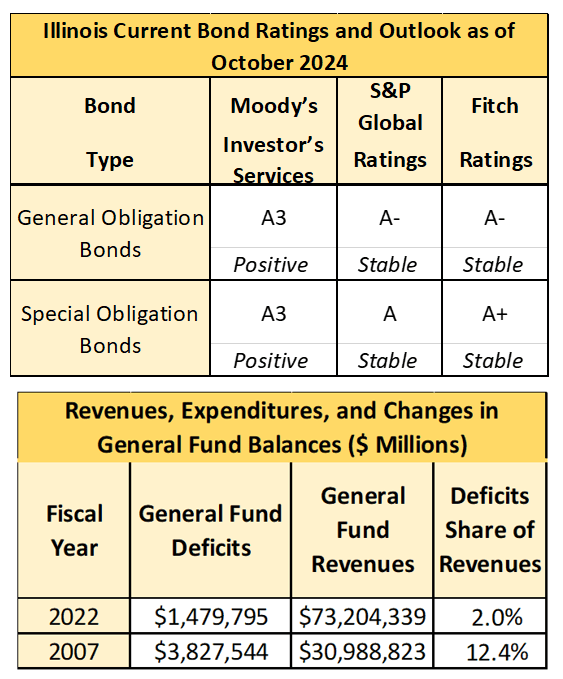
- Eliminated the General Fund deficit and bill backlog, earning a total of nine credit rating upgrades since 2020 that will allow the State to borrow at lower interest rates.
- Achieved its largest ever Budget Stabilization Fund (or “Rainy Day” Fund) balance at more than $2 billion–nearly 700 percent larger than it was prior to the Great Recession.
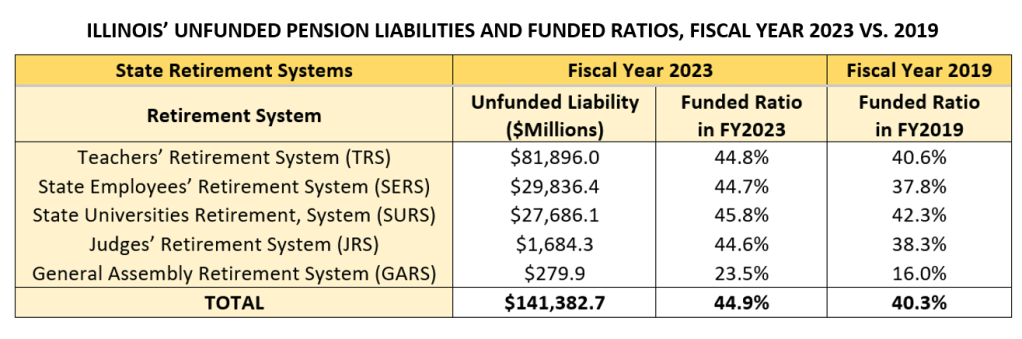
- Improved the funded ratio of its State retirement systems to its highest level since 2008.
- Rebuilt its Unemployment Insurance Trust Fund balance to $2 billion.
- Implemented a work-share program that allows employers to avoid layoffs by temporarily reducing employees’ hours while enabling workers to receive prorated unemployment insurance benefits.
- Invested $2 billion more annually in public education—reducing the number of school districts in financial deficit by 55%—while increasing grants to make college more affordable by 77%.
- Established dedicated revenue streams that, together with federal funding, will invest $41 billion in roads, bridges, public transit systems, rail, and aviation infrastructure over the next six years.
- Committed to investments in climate resiliency and carbon-free nuclear power that are creating thousands of jobs on the path to 100 percent clean energy.
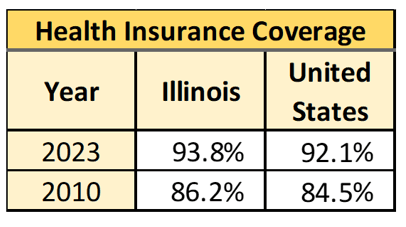
- Through the expansion of Medicaid under the Affordable Care Act, Illinois has reduced its number of residents without health insurance by nearly 1 million, a 56% decrease.
“Periodic economic contractions present real challenges to employers, working families, and policymakers alike,” said PMCR Director and University of Illinois at Urbana-Champaign Professor Dr. Robert Bruno. “While no state is recession-proof, Illinois has prioritized prudence in its fiscal management, long-term competitiveness in its public investments, and has pursued public policies that prior recession resiliency research indicates can minimize the impact of economic disruptions.”
While researchers point out that Illinois has taken significant steps to get its fiscal house in order and make public investments that would protect jobs and vital services in any economic contingency, they note that the state’s pension system will warrant continued vigilance and that reforms to the state’s tax structure could present opportunities for greater economic and fiscal stability over the long term.
“Illinois has made important strides in its public pension system by making required contributions that had been jettisoned in prior years, offering $2 billion in buyouts to retiring employees and inactive members and making $700 million in supplemental contributions designed to reduce the system’s unfunded liabilities. It is important for the state to continue on this trajectory, which would bring the system 90% funded by 2045—well above the 80% standard used by the Government Accountability Office,” Manzo added.
“Illinois’ current tax structure is a mixed bag that can be both a help and hindrance when it comes to recessions,” concluded Dr. Bruno. “Our sales tax system doesn’t cover most services, which can invite fiscal headwinds during lean times. And, while our reliance on property taxes and flat income tax structure promotes more stable and predictable public service funding during downturns, it can also constrain the state’s ability to invest higher-than-expected revenues into rainy day reserves or other long-term economic fortifications during good times.”
The Illinois Economic Policy Institute (ILEPI) is a nonprofit organization which uses advanced statistics and the latest forecasting models to promote economic growth for businesses and working families.
The Project for Middle Class Renewal (PMCR) at the University of Illinois at Urbana-Champaign investigates the working conditions of workers in today’s economy to elevate public discourse aimed at reducing poverty, create more stable forms of employment, and promote middle-class jobs.
 The Illinois Update