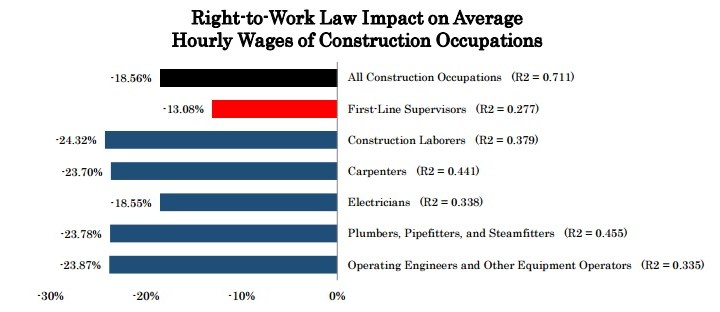
Construction Workers Are the Major Victims of Right-to-Work Laws

Frank Manzo IV is the Policy Director of the Illinois Economic Policy Institute (ILEPI). Visit ILEPI at http://www.illinoisepi.org or follow ILEPI on Twitter @illinoisEPI. “Right-to-work” laws have the largest negative impacts on construction workers, according to a new ILEPI Economic … Continue reading Construction Workers Are the Major Victims of Right-to-Work Laws

Over 250,000 Illinois Workers Earn Less than the Minimum Wage

Frank Manzo IV is the Policy Director of the Illinois Economic Policy Institute (ILEPI). Visit ILEPI at www.illinoisepi.org or follow ILEPI on Twitter @illinoisEPI.


Analysis of new data from the Current Population Survey (conducted jointly by the U.S. Bureau of Labor Statistics and the U.S. Census Bureau) reveals that 4.8 percent of the Illinois workforce earns less than $8.25 an hour, the legal minimum wage for workers aged 18 years or older in firms with 4 or more employees. In total, an estimated 264,508 workers earned less than the minimum wage in 2014. Among sub-minimum wage earners (SMWEs), hourly pay averages just $6.66, or $1.59 per hour below the minimum wage floor. This translates into an economic loss of $1,654 over the year for part-time employees who worked 20 hours per week in 2014.

While many of these workers are under 18 years old or are employed by small businesses excluded from the minimum wage law, many others are the victims of wage theft. A 2009 study by researchers at the National Employment Law Project, the University of Illinois at Chicago, Cornell University, and the University of California – Los Angeles found that 26 percent of low-wage, “front-line” workers were paid less than the legally-required minimum wage. The highest violation rates occurred in apparel and textile manufacturing, private households, and personal and repair services. Similarly, in a survey of 57 car washes in the City of Chicago, the University of Illinois at Urbana-Champaign found that 76 percent of hand car wash workers earned below the state’s minimum wage and 13 percent earned less than $2 per hour.

Minimum wage theft occurs for many reasons. First, there could be information problems in that employers may not realize that their practices are depriving workers of owed income or that they have misclassified workers as temporary or contingent workers. Second, tipped employees may not be compensated by their employer enough to close the minimum wage gap when the tips fall short. Third, business practices that elevate short-term profits above long-term profitability put downward pressures on wages. Fourth, economically inefficient social issues such as racial, gender, sexual orientation, and religious discrimination could also be factors. Continue reading “Over 250,000 Illinois Workers Earn Less than the Minimum Wage”

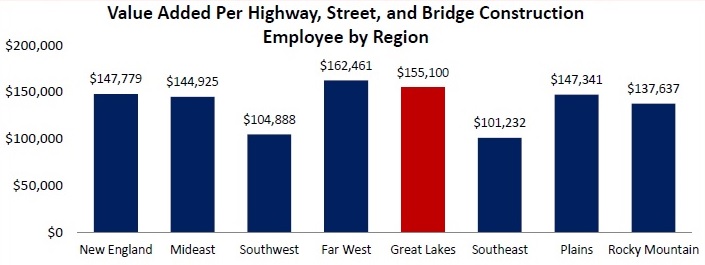
Road Construction Workers in the Midwest are VERY Productive

Frank Manzo IV is the Policy Director of the Midwest Economic Policy Institute (MEPI). Visit MEPI online follow the affiliated Illinois Economic Policy Institute on Twitter @illinoisEPI. Construction workers who specialize in road and bridge infrastructure projects are productive, high-skilled, and well-paid in the Midwest, … Continue reading Road Construction Workers in the Midwest are VERY Productive

Fact Checking Governor Rauner

Frank Manzo IV is the Policy Director of the Illinois Economic Policy Institute (ILEPI). Visit ILEPI at www.illinoisepi.org or follow ILEPI on Twitter @illinoisEPI.


Today the Illinois Economic Policy Institute (ILEPI) released A Turnaround or a Turn Aground? Fact Checking Governor Rauner’s First Claims (PDF). The report evaluates statements made by new Governor Bruce Rauner during his first month in office. Governor Rauner’s ambitious policy agenda aims to fix Illinois’ fiscal crisis mainly through a constitutional amendment on public sector pensions, changes to the state’s tax code, and adjustments to the state’s labor laws– including banning political contributions from certain labor unions and implementing local right-to-work laws which reduce the power of unions. Would his proposals, if enacted, accomplish his goal of making Illinois a “competitive” and “compassionate” state? Are his policy proposals supported by evidence and fact? Of the eleven claims analyzed, ILEPI finds that:

  • Two (18.2 percent) were found to be true,
  • Three (27.3 percent) were rated as only half true, and
  • Six (54.5 percent) were deemed to be false.

A summary of the fact check is below:

ONLY HALF TRUE: Illinois Job Creation Lags Behind Neighboring States

Rauner’s numbers are misleading and may be out of date. While the Illinois labor market has lagged slightly behind the economies of neighboring states, the actual disparity is much smaller than Rauner suggests. The largest year-over-year unemployment rate decline in America occurred in Illinois, where the unemployment rate fell by 2.7 percentage points. Using correct payroll data, this claim is found to be only half true.

FALSE: Illinois is Currently a Bad Place to Do Business

Outcomes matter. Rauner uses rankings of corporate executives to suggest that Illinois is a terrible place to do business, but the claims have no predictive power of a state’s unemployment rate and are negatively correlated with average wages in a state. A good state for business should be statistically related to lower unemployment and higher worker wages. The appropriate policy is to attract high-road employers with sound infrastructure and a skilled workforce. After completing the rest of the story, the claim that Illinois is a bad state in which to do business is found to be false.

TRUE: Raising the Minimum Wage to $10.00 Will Increase Earnings

To generate full economic benefits, the minimum wage should be expanded to cover employers with 2 or more employees, indexed to the chained-Consumer Price Index, paired with an expansion of the state’s Earned Income Tax Credit, and be applicable to workers in their first 90 days of employment. Without these additions to the new minimum wage law, this claim will only be half true. With meaningful change, this claim is found to be true.

FALSE: Right-to-Work Would Help Workers in Illinois Continue reading “Fact Checking Governor Rauner”

A Quick Comment on Government Unions in Illinois

Frank Manzo IV is the Policy Director of the Illinois Economic Policy Institute (ILEPI). Visit ILEPI at www.illinoisepi.org or follow ILEPI on Twitter @illinoisEPI.


Yesterday the Illinois Policy Institute (IPI) released “The Anatomy of Influence: Government Unions in Illinois,” perhaps-not-so-coincidentally on the same day that Governor Rauner passed an executive order prohibiting public sector unions from paying fair share fees to fund union activities. In usual IPI fashion, the report only tells a small component of the whole story. Below are a few thoughts on the report.

Report quote: ” At both the IEA and the Illinois Federation of Teachers or IFT, the top 20 highest-paid employees all are paid salaries of more than $100,000 annually.”

The IEA and the IFT represent about 214,000 workers in Illinois combined, according to the report. These 40 individuals’ salaries represent 0.02% of all members. By contrast, data from the American Community Survey 1-Year Estimates for 2013 reveal that the Top 10% of all workers in Illinois earned at least $100,000 in real total income and the Top 1% earns $475,000 or more [Note: See the STATA output above, which reports weighted estimates for 59,743 Illinois residents who are in the labor force and are employed]. The fact that 40 salaries in the IEA and IFT are above $100,000 is utterly meaningless when contrasted with the rest of the Illinois labor market.

There is a myth about the “overpaid” labor union leader. In a report released last month with the University of Illinois Labor Education Program, ILEPI debunked that myth (PDF) from a national perspective. The report provides a complete story by comparing and contrasting (perhaps a novel idea these days…). We concluded:

Unions raise and compress wages, and union leaders are compensated accordingly. The typical labor union is neither large nor lucrative, with average compensation packages to employees that are similar to social advocacy, community services, and worker services groups. Payroll costs are much lower in labor organizations than they are in business associations (such as chambers of commerce), in law offices, and among managers of companies and enterprises. Additionally, labor leaders and top administrative staff are not paid more than the market rate for other leaders and administrators. In fact, they tend to earn far less than comparable CEOs and executives in relevant industries. Thus, there is no evidence to support any claim of “Big” labor, with unions governed by overcompensated leaders.

Once again, here is a link to that paper.

Report quote: “The Illinois Policy Institute reviewed campaign-finance reports from 2002 to 2014 and found the five major government unions in Illinois spent a combined $46 million in political campaigns in that time.”

According to FollowTheMoney.org, $1.29 billion has been contributed to statewide political campaigns in Illinois since 2002. In the context of all campaign contributions, the $46 million influence of public sector unions represents just 3.6 percent of all campaign contributions. Furthermore, during that exact same time, Bruce Rauner contributed $39.6 million to political campaigns. Once again, that is $46 million dollars representing hundreds of thousands of public sector workers (3.6 percent) versus nearly $40 million from one businessman (3.1 percent). Let’s get real about the influence of money in politics here. Continue reading “A Quick Comment on Government Unions in Illinois”

Union Power in 2014: Significant but Waning

Frank Manzo IV is the Policy Director of the Illinois Economic Policy Institute (ILEPI). Visit ILEPI at www.illinoisepi.org or follow ILEPI on Twitter @illinoisEPI.


Today, the Illinois Economic Policy Institute (ILEPI) released a new Research Report on the Illinois labor movement. Co-authored with researchers from the University of Illinois Labor Education Program (LEP) and University of Chicago School of Social Service Administration (SSA), The State of the Unions 2014: A Profile of Unionization in Chicago, in Illinois, and in America ­(PDF) analyzes the current state of labor unions and the course of unionization. The report investigates unionization rates and the impact of unions on wages across demographic, education, sector, industry, and occupation classifications.

Below are the main findings of the report, which is available online at this link (PDF):

  • There are approximately 116,000 fewer union members in Illinois today than there were in 2003 (and about 1.26 million fewer nationwide);
  • The decline in union members was primarily the result of decreases in male unionization, white unionization, and private sector unionization;
  • Despite the long-term downward trends, however, unionization increased in Illinois last year (from 14.6 percent to 15.7 percent- or by about 50,000 new members);
  • The year-over-year gains were driven by increases in the unionization of Chicago area workers, female workers, African-American workers, public sector workers, and older workers. Indeed, while union membership rates for women, African-American workers, and the public sector have trended downwards nationally, unionization for these groups has risen in Illinois since 2003;
  • Employment in the utilities industry, construction industry, or public sector raises the chances that a given Illinois worker is a union member;
  • High school dropouts, non-citizens, and residents who live in rural communities are less likely to be unionized in Illinois;
  • Unions raise worker wages by 21.4 percent on average (20.3 percent on median) in Illinois, higher than the national average of 16.7 percent;
  • Illinois ranks 8th among the 50 states plus D.C. in terms of union wage premium; and
  • Union workers work 4.8 hours longer each week than nonunion workers in Illinois.


Separately, ILEPI has also released another Economic Commentary jointly with the University of Illinois Labor Education Program on the socioeconomic differences between union households and nonunion households in America. Union and Nonunion Households: General Social Survey, 2000-2012 (PDF) compares and contrasts individuals in the two types of households across many characteristics– including household composition, work and income traits, religiosity, political affiliation, and institutional confidence. Continue reading “Union Power in 2014: Significant but Waning”