Study – Union Power in Illinois is Significant, but Waning

Frank Manzo IV is the Policy Director of the Illinois Economic Policy Institute (ILEPI). Visit ILEPI at www.illinoisepi.org or follow ILEPI on Twitter @illinoisEPI.


CHICAGO- A new study released today finds that labor unions play a vital role in Illinois’ communities and economy, but face major challenges. The study, The State of the Unions 2015: A Profile of Unionization in Chicago, in Illinois, and in America [PDF] was conducted by researchers at the University of Illinois (Robert Bruno, PhD), the University of Chicago (Virginia Parks, PhD), and the Illinois Economic Policy Institute (Frank Manzo IV, MPP).

Since 2005, union membership in Illinois has declined by approximately 97,000 workers, contributing to the 1.12 million drop in union members across the nation. Declining unionization in Illinois has primarily been the result of decreases in male, Latino/a, and private sector unionization.

However, there has been some good news for those in the Illinois labor movement. From 2012 to 2014, the state’s unionization rate increased from 14.6 percent to 15.1 percent, and total union membership increased by about 30,000 workers. Continue reading “Study – Union Power in Illinois is Significant, but Waning”

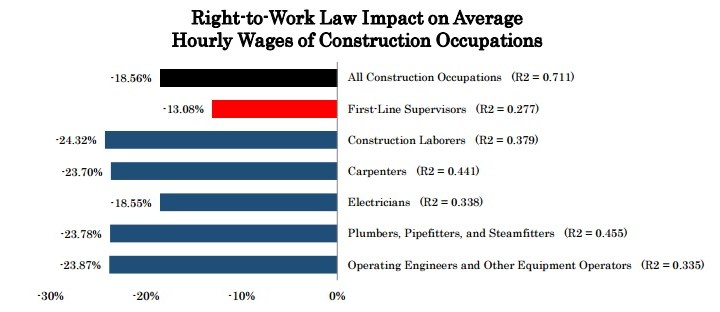
Construction Workers Are the Major Victims of Right-to-Work Laws

Frank Manzo IV is the Policy Director of the Illinois Economic Policy Institute (ILEPI). Visit ILEPI at http://www.illinoisepi.org or follow ILEPI on Twitter @illinoisEPI. “Right-to-work” laws have the largest negative impacts on construction workers, according to a new ILEPI Economic … Continue reading Construction Workers Are the Major Victims of Right-to-Work Laws

Over 250,000 Illinois Workers Earn Less than the Minimum Wage

Frank Manzo IV is the Policy Director of the Illinois Economic Policy Institute (ILEPI). Visit ILEPI at www.illinoisepi.org or follow ILEPI on Twitter @illinoisEPI.


Analysis of new data from the Current Population Survey (conducted jointly by the U.S. Bureau of Labor Statistics and the U.S. Census Bureau) reveals that 4.8 percent of the Illinois workforce earns less than $8.25 an hour, the legal minimum wage for workers aged 18 years or older in firms with 4 or more employees. In total, an estimated 264,508 workers earned less than the minimum wage in 2014. Among sub-minimum wage earners (SMWEs), hourly pay averages just $6.66, or $1.59 per hour below the minimum wage floor. This translates into an economic loss of $1,654 over the year for part-time employees who worked 20 hours per week in 2014.

While many of these workers are under 18 years old or are employed by small businesses excluded from the minimum wage law, many others are the victims of wage theft. A 2009 study by researchers at the National Employment Law Project, the University of Illinois at Chicago, Cornell University, and the University of California – Los Angeles found that 26 percent of low-wage, “front-line” workers were paid less than the legally-required minimum wage. The highest violation rates occurred in apparel and textile manufacturing, private households, and personal and repair services. Similarly, in a survey of 57 car washes in the City of Chicago, the University of Illinois at Urbana-Champaign found that 76 percent of hand car wash workers earned below the state’s minimum wage and 13 percent earned less than $2 per hour.

Minimum wage theft occurs for many reasons. First, there could be information problems in that employers may not realize that their practices are depriving workers of owed income or that they have misclassified workers as temporary or contingent workers. Second, tipped employees may not be compensated by their employer enough to close the minimum wage gap when the tips fall short. Third, business practices that elevate short-term profits above long-term profitability put downward pressures on wages. Fourth, economically inefficient social issues such as racial, gender, sexual orientation, and religious discrimination could also be factors. Continue reading “Over 250,000 Illinois Workers Earn Less than the Minimum Wage”

Fact Checking Governor Rauner

Frank Manzo IV is the Policy Director of the Illinois Economic Policy Institute (ILEPI). Visit ILEPI at www.illinoisepi.org or follow ILEPI on Twitter @illinoisEPI.


Today the Illinois Economic Policy Institute (ILEPI) released A Turnaround or a Turn Aground? Fact Checking Governor Rauner’s First Claims (PDF). The report evaluates statements made by new Governor Bruce Rauner during his first month in office. Governor Rauner’s ambitious policy agenda aims to fix Illinois’ fiscal crisis mainly through a constitutional amendment on public sector pensions, changes to the state’s tax code, and adjustments to the state’s labor laws– including banning political contributions from certain labor unions and implementing local right-to-work laws which reduce the power of unions. Would his proposals, if enacted, accomplish his goal of making Illinois a “competitive” and “compassionate” state? Are his policy proposals supported by evidence and fact? Of the eleven claims analyzed, ILEPI finds that:

  • Two (18.2 percent) were found to be true,
  • Three (27.3 percent) were rated as only half true, and
  • Six (54.5 percent) were deemed to be false.

A summary of the fact check is below:

ONLY HALF TRUE: Illinois Job Creation Lags Behind Neighboring States

Rauner’s numbers are misleading and may be out of date. While the Illinois labor market has lagged slightly behind the economies of neighboring states, the actual disparity is much smaller than Rauner suggests. The largest year-over-year unemployment rate decline in America occurred in Illinois, where the unemployment rate fell by 2.7 percentage points. Using correct payroll data, this claim is found to be only half true.

FALSE: Illinois is Currently a Bad Place to Do Business

Outcomes matter. Rauner uses rankings of corporate executives to suggest that Illinois is a terrible place to do business, but the claims have no predictive power of a state’s unemployment rate and are negatively correlated with average wages in a state. A good state for business should be statistically related to lower unemployment and higher worker wages. The appropriate policy is to attract high-road employers with sound infrastructure and a skilled workforce. After completing the rest of the story, the claim that Illinois is a bad state in which to do business is found to be false.

TRUE: Raising the Minimum Wage to $10.00 Will Increase Earnings

To generate full economic benefits, the minimum wage should be expanded to cover employers with 2 or more employees, indexed to the chained-Consumer Price Index, paired with an expansion of the state’s Earned Income Tax Credit, and be applicable to workers in their first 90 days of employment. Without these additions to the new minimum wage law, this claim will only be half true. With meaningful change, this claim is found to be true.

FALSE: Right-to-Work Would Help Workers in Illinois Continue reading “Fact Checking Governor Rauner”

Right-to-Work States are Free-Rider States

Frank Manzo IV is the Policy Director of the Illinois Economic Policy Institute (ILEPI). Visit ILEPI at www.illinoisepi.org or follow ILEPI on Twitter @illinoisEPI.


Today, the Illinois Economic Policy Institute and the University of Illinois jointly released Free-Rider States: How Low-Wage Employment in “Right-to-Work” States is Subsidized by the Economic Benefits of Collective Bargaining [PDF]. The report has three main findings:

  1. Right-to-work laws have negative impacts on the public budget;
  2. Workers in collective-bargaining states are subsidizing the low-wage model used by employers in right-to-work states; and
  3. Illinois would have been worse off if it was a right-to-work state in 2013.

A “right-to-work” law reduces worker earnings by 3.2 percent, reduces union membership by 9.6 percentage points, reduces the share of workers covered by a health insurance plan (3.5 percentage points) and by a pension plan (3.0 percentage points), and increases the poverty rate among workers by 0.9 percentage points.

All of this has negative impacts on the public budget. Lower worker earnings decrease income tax contributions: a right-to-work law lowers the after-credit federal income tax liability of workers by 11.1 percent. Lower worker earnings also increase the chances of a worker needing to rely on government assistance programs: workers in collective-bargaining states receive 18.9 percent less in tax relief from the Earned Income Tax Credit and 14.1 percent less in food stamp value than their counterparts in right-to-work states.

Additionally, right-to-work laws have inconclusive impacts on employment. While the report finds that they are associated with a small increase in hours and weeks worked by employees, this is likely because they are forced to work more time to earn anything close to their annual income in a collective-bargaining state. Furthermore, two case-studies using data from the Bureau of Labor Statistics illustrate how right-to-work states have negligible impacts on total employment:

  1. In March 2012, Indiana enacted right-to-work. From March 2012 through July 2014, the Indiana unemployment rate fell from 8.0 percent to 5.9 percent– a 2.1 percentage point drop. At the same time, the unemployment rate of collective-bargaining Illinois fell by 2.0 percentage points. This difference is statistically insignificant.
  2. In January 2013, Michigan enacted right-to-work. From January 2013 through July 2014, the Michigan unemployment rate fell from 8.9 percent to 7.7 percent– a 1.2 percentage point drop. At the same time, the unemployment rate of collective-bargaining Illinois fell by 2.4 percentage points. This difference is significant, and shows how a right-to-work law does not lead to improved employment outcomes.

Continue reading “Right-to-Work States are Free-Rider States”

McHenry County Should Adopt Its Prevailing Wage Ordinance

Frank Manzo IV is the Policy Director of the Illinois Economic Policy Institute (ILEPI). Visit ILEPI at www.illinoisepi.org or follow ILEPI on Twitter @illinoisEPI. The call by McHenry County Board Members to partner with other county governments to challenge Illinois’ prevailing wage determinations would be a waste of government resources, according to a new study by the Illinois Economic Policy Institute. The report, Building a Strong McHenry: How Prevailing Wage Works [PDF], finds that prevailing wage is necessary to prevent government bodies– such as the McHenry County Board– from using their massive purchasing power to undercut the established labor market. The policy is also … Continue reading McHenry County Should Adopt Its Prevailing Wage Ordinance

The CCW is Common Sense Construction

Today, the Midwest Economic Policy Institute released Common Sense Construction: The Economic Impacts of  Indiana’s Common Construction Wage with the University of Illinois School of Labor and Employment Relations and Smart Cities Prevail. The report finds that Indiana’s Common Construction Wage (CCW) promotes positive labor market outcomes for both construction workers and contractors. Full report [pdf] One-page summary [pdf] Ten facts about the Indiana CCW: 1. The Common Construction Wage keeps Hoosier jobs local. (For more, see pages 5 and 11-13) 2. The Common Construction Wage does not increase total construction costs for public projects. (Pg. 4) 3. The Common Construction Wage promotes an upwardly-mobile, high-road economy for working families. (Pg. … Continue reading The CCW is Common Sense Construction

ICYMI: ILEPI on Chicago Tonight Discussing Minimum Wage

Frank Manzo IV is the Policy Director of the Illinois Economic Policy Institute (ILEPI). Visit ILEPI at www.illinoisepi.org or follow ILEPI on Twitter @illinoisEPI.


On May 20, 2014, ILEPI Policy Director Frank Manzo IV was a panelist on WTTW’s Chicago Tonight with Ted Dabrowski discussing the pros and cons of raising the minimum wage in Illinois. Manzo supported raising the minimum wage to $10.00 per hour while Dabrowski has endorsed abolishing Illinois’ minimum wage altogether. Here is a link to the segment, and below is additional information on the effects of raising the minimum wage in Illinois.


Should we raise the minimum wage to $10 an hour?

The Illinois economy is still recovering from the Great Recession. The unemployment rate is about one and a half percentage points lower today than it was one year ago. But the recovery has seen an ongoing rise in income inequality in the labor market. To partially offset the income gap– independent of any action (or nonaction) at the federal level– Illinois should raise the minimum wage to $10 an hour.

In 2012, 1 million of the state’s 6 million workers earned less than $10 an hour. Of these one million low-wage earners, 57 percent were female, 45 percent were nonwhite, and 60 percent worked full-time (35 hours a week or more). In a study co-authored with the University of Illinois, ILEPI found that raising the minimum wage to $10 would increase worker income by $2 billion for these low-wage workers and lift 60,000 to 100,000 Illinois residents above the poverty line, reducing reliance on government programs and lowering costs to taxpayers. These workers would then spend that new income back in the economy, resulting in $7 billion in new economic output, and either a very small drop or a very small gain in employment. Thus, in Illinois, a state where the cost of living is higher than the national average, a raise to $10 would be beneficial to the economy. See the full report here [pdf].

Why does the minimum wage have a stimulative impact? What about economic theory which says it reduces jobs?

We know that reality is, unfortunately, far more complex than economic theory. Research shows little to no discernible impact of the minimum wage on employment. Most estimates on the supposed reduction in jobs are between zero percent and less than a fraction of a percent— it would be a false representation of economic research to suggest otherwise. We also know that poorer Americans spend higher shares of their incomes in the economy than richer Americans. One 2009 study by the Federal Reserve Bank of Chicago found that “spending increases substantially after a minimum wage hike.” For every $1 increase in the minimum wage, families with a minimum wage earner raise spending by $744 to $869 per year.

Isn’t the minimum wage a job killer for small businesses? Continue reading “ICYMI: ILEPI on Chicago Tonight Discussing Minimum Wage”

Union Power in 2014: Significant but Waning

Frank Manzo IV is the Policy Director of the Illinois Economic Policy Institute (ILEPI). Visit ILEPI at www.illinoisepi.org or follow ILEPI on Twitter @illinoisEPI.


Today, the Illinois Economic Policy Institute (ILEPI) released a new Research Report on the Illinois labor movement. Co-authored with researchers from the University of Illinois Labor Education Program (LEP) and University of Chicago School of Social Service Administration (SSA), The State of the Unions 2014: A Profile of Unionization in Chicago, in Illinois, and in America ­(PDF) analyzes the current state of labor unions and the course of unionization. The report investigates unionization rates and the impact of unions on wages across demographic, education, sector, industry, and occupation classifications.

Below are the main findings of the report, which is available online at this link (PDF):

  • There are approximately 116,000 fewer union members in Illinois today than there were in 2003 (and about 1.26 million fewer nationwide);
  • The decline in union members was primarily the result of decreases in male unionization, white unionization, and private sector unionization;
  • Despite the long-term downward trends, however, unionization increased in Illinois last year (from 14.6 percent to 15.7 percent- or by about 50,000 new members);
  • The year-over-year gains were driven by increases in the unionization of Chicago area workers, female workers, African-American workers, public sector workers, and older workers. Indeed, while union membership rates for women, African-American workers, and the public sector have trended downwards nationally, unionization for these groups has risen in Illinois since 2003;
  • Employment in the utilities industry, construction industry, or public sector raises the chances that a given Illinois worker is a union member;
  • High school dropouts, non-citizens, and residents who live in rural communities are less likely to be unionized in Illinois;
  • Unions raise worker wages by 21.4 percent on average (20.3 percent on median) in Illinois, higher than the national average of 16.7 percent;
  • Illinois ranks 8th among the 50 states plus D.C. in terms of union wage premium; and
  • Union workers work 4.8 hours longer each week than nonunion workers in Illinois.


Separately, ILEPI has also released another Economic Commentary jointly with the University of Illinois Labor Education Program on the socioeconomic differences between union households and nonunion households in America. Union and Nonunion Households: General Social Survey, 2000-2012 (PDF) compares and contrasts individuals in the two types of households across many characteristics– including household composition, work and income traits, religiosity, political affiliation, and institutional confidence. Continue reading “Union Power in 2014: Significant but Waning”

On the Fallacious Argument of One Right-to-Work Advocate

Frank Manzo IV is the Policy Director of the Illinois Economic Policy Institute (ILEPI). Visit ILEPI at www.illinoisepi.org or follow ILEPI on Twitter @illinoisEPI. This post is a response to an article written by Stan Greer of the National Institute for Labor Relations Research on February 10, 2014. The article “reported” (for lack of a better term) on a recent study conducted jointly by ILEPI and the University of Illinois.  For reference, our study, Which Labor Market Institutions Reduce Income Inequality? Labor Unions, Prevailing Wage Laws, and Right-to-Work Laws in the Construction Industry can be found here [PDF] and an accompanying Illinois Insights Blog post … Continue reading On the Fallacious Argument of One Right-to-Work Advocate