New Study: Michigan Prevailing Wage Repeal Will Kill Jobs and Hamper Economy

Frank Manzo IV is the Policy Director of the Illinois Economic Policy Institute (ILEPI). Visit ILEPI at www.illinoisepi.org or follow ILEPI on Twitter @illinoisEPI. Lansing – Just completed research by the Midwest Economic Policy Institute, Colorado State University Economist Kevin Duncan … Continue reading New Study: Michigan Prevailing Wage Repeal Will Kill Jobs and Hamper Economy

Construction Workers Are the Major Victims of Right-to-Work Laws

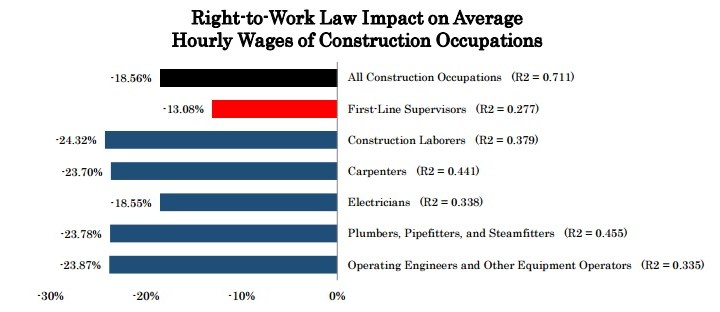
Frank Manzo IV is the Policy Director of the Illinois Economic Policy Institute (ILEPI). Visit ILEPI at http://www.illinoisepi.org or follow ILEPI on Twitter @illinoisEPI. “Right-to-work” laws have the largest negative impacts on construction workers, according to a new ILEPI Economic … Continue reading Construction Workers Are the Major Victims of Right-to-Work Laws

McHenry County Should Adopt Its Prevailing Wage Ordinance

Frank Manzo IV is the Policy Director of the Illinois Economic Policy Institute (ILEPI). Visit ILEPI at www.illinoisepi.org or follow ILEPI on Twitter @illinoisEPI. The call by McHenry County Board Members to partner with other county governments to challenge Illinois’ prevailing wage determinations would be a waste of government resources, according to a new study by the Illinois Economic Policy Institute. The report, Building a Strong McHenry: How Prevailing Wage Works [PDF], finds that prevailing wage is necessary to prevent government bodies– such as the McHenry County Board– from using their massive purchasing power to undercut the established labor market. The policy is also … Continue reading McHenry County Should Adopt Its Prevailing Wage Ordinance

Prevailing Wage Encourages Self-Sufficient Workers

Frank Manzo IV is the Policy Director of the Illinois Economic Policy Institute (ILEPI). Visit ILEPI at www.illinoisepi.org or follow ILEPI on Twitter @illinoisEPI. Taxpayers are subsidizing the low-wage, low-skill, low-quality system in states without a prevailing wage law, according to a report released jointly today by the Midwest Economic Policy Institute and Building Strong Communities. The Policy Brief, Self-Sufficient Construction Workers: Why Prevailing Wage Laws are the Best Deal for Taxpayers [PDF], finds that prevailing wage laws (PWLs) build local middle-class jobs and drive economic development through increased consumer demand. By paying a living wage and supporting apprenticeship training programs, PWLs encourage … Continue reading Prevailing Wage Encourages Self-Sufficient Workers

The CCW is Common Sense Construction

Today, the Midwest Economic Policy Institute released Common Sense Construction: The Economic Impacts of  Indiana’s Common Construction Wage with the University of Illinois School of Labor and Employment Relations and Smart Cities Prevail. The report finds that Indiana’s Common Construction Wage (CCW) promotes positive labor market outcomes for both construction workers and contractors. Full report [pdf] One-page summary [pdf] Ten facts about the Indiana CCW: 1. The Common Construction Wage keeps Hoosier jobs local. (For more, see pages 5 and 11-13) 2. The Common Construction Wage does not increase total construction costs for public projects. (Pg. 4) 3. The Common Construction Wage promotes an upwardly-mobile, high-road economy for working families. (Pg. … Continue reading The CCW is Common Sense Construction

Collaborative Development: The Benefits of Public-Private Partnerships

Frank Manzo IV is the Policy Director of the Illinois Economic Policy Institute (ILEPI). Visit ILEPI at www.illinoisepi.org or follow ILEPI on Twitter @illinoisEPI.


A new ILEPI Policy Brief, released this morning, investigates the pros and cons of public-private partnerships in the construction industry. [Update: The Monitor article].

The report, Collaborative Development: The Pros and Cons of P3s on Construction Projects (PDF), finds that public-private partnerships (P3s)– such as the proposed Illiana Expressway– offer the potential for significant cost savings for the public sector. P3s allow governments to increase internal investment, capitalize on the efficiencies and innovations of private companies, and build infrastructure slightly less expensively and slightly more quickly. For the private sector, P3s provide stable assets (infrastructure facilities) with predictable long-term returns from user fees for portfolio diversification. P3s also allow private entities, backed by the government, to borrow cheaply.

The Policy Brief utilizes case studies to demonstrate how P3s may be mutually beneficial and discusses the expected positive benefits of three potential P3 projects in the Midwest: Continue reading “Collaborative Development: The Benefits of Public-Private Partnerships”

@SaveTheWage: Defending Common Construction Wage in Indiana

Frank Manzo IV is the Policy Director of the Illinois Economic Policy Institute (ILEPI). Visit ILEPI at www.illinoisepi.org or follow ILEPI on Twitter @illinoisEPI. The Illinois Economic Policy Institute (ILEPI) is pleased to announce the launch of @SaveTheWage! The Save The Wage campaign is led by a coalition of organizations committed to defending Indiana’s Common Construction Wage (also called “CCW” or the “prevailing wage”) from unjustified claims and attacks. Supported primarily by the Illinois Economic Policy Institute (@IllinoisEPI), Union One (@Union1), and the Indiana, Illinois, Iowa Foundation for Fair Contracting, Save The Wage aims to promote education, awareness, and public discussion around the benefits of … Continue reading @SaveTheWage: Defending Common Construction Wage in Indiana

ILEPI Releases Report on the Benefits of Doing Business in Illinois

Frank Manzo IV is the Policy Director of the Illinois Economic Policy Institute (ILEPI). Visit ILEPI at www.illinoisepi.org or follow ILEPI on Twitter @illinoisEPI.

Today, ILEPI released a Policy Brief on The Benefits of Doing Business in Illinois [pdf].

Too often, the public policy discourse is focused on costs. The costs of labor, the costs of transportation, the costs of taxes. Costs, costs, costs. Lost in the discourse is an emphasis on the benefits of policies.

The Benefits of Doing Business in Illinois finds that – despite sluggish economic growth, a high unemployment rate, and moderately high tax rates – Illinois remains a great place to do business. Below are 10 important facts found in the report about Illinois’ pro-business environment:

1. After adjusting for inflation, the Illinois economy has grown by 10.6 percent since 2000. This growth is less than the nation as a whole (19.6 percent), but higher than the rest of Illinois’ neighbors put together (7.6 percent). The Illinois economy has expanded by more than the greater region since 2005 as well.

2. Per capita personal income has grown by $1,510 since 2005 and is now $45,832 in Illinois. The national average is $43,735 while the average for Illinois’ neighbors is just $40,165. Income growth has been about 3.5 percent for all regions. Higher incomes translate into higher consumer demand in the Illinois market. Continue reading “ILEPI Releases Report on the Benefits of Doing Business in Illinois”

About That… Addressing Illinois Unemployment

Frank Manzo IV is the Policy Director of the Illinois Economic Policy Institute (ILEPI). Visit ILEPI at www.illinoisepi.org or follow ILEPI on Twitter @illinoisEPI.

Today the Bureau of Labor Statistics published its monthly “Regional and State Employment and Unemployment” report. At 8.9 percent, the Illinois unemployment rate is 4th highest in the nation, behind only Nevada (9.3 percent), Rhode Island (9.2 percent), and Michigan (9.0 percent[1]). Since September 1, the Illinois unemployment rate has fallen by 0.3 percentage points, the number of unemployed individuals has declined by 22,436 individuals, and the number of residents with a job has increased by 16,079.

These numbers raise two important issues. First, in the absence of the government shutdown of October 1 to October 16, the Illinois unemployment rate would have been lower, likely by a tenth of a percentage point. Second, compared to the U.S. unemployment rate of 7.3 percent (which ticked up in part due to the government shutdown), the Illinois rate remains significantly elevated.

On October 1, 2013, ILEPI published a report in which we asked, “Who are the unemployed in Illinois?” Our analysis was based on monthly CPS-ORG data and was adjusted to the levels of September 1, 2013 when the Illinois unemployment rate was 9.2 percent and 602,000 residents were out of work. We found that the unemployed are disproportionately male, young, and African-American and Latino/a, although white workers still constitute a majority (53.9%) of the unemployed. Those with lower levels of education are also overrepresented in the unemployment pool, but there were still 109,000 unemployed individuals with at least a bachelor’s degree in Illinois.

Additionally, particular industries had also been hit harder than others. 16.8 percent of all construction workers were out of work and the arts and entertainment services (15.5 percent), accommodation services (15.2 percent), and food services (14.2 percent) industries all followed. In total, workers from just five industries made up over half of all unemployed workers in Illinois. Although at 5.2 percent, the combined education, health, and social services sector had an unemployment rate well below the state’s average, it was the most frequent industry of previous employment in the unemployment pool, at 76,000 workers. 71,000 individuals from the professional, science, and management services sector were also out of work as well as 63,000 construction workers, 61,000 retail trade employees, and 59,000 food services workers are unemployed in 2013.

Given that Illinois’ unemployment rate only slightly declined since the end of August and that the pool of unemployed workers remains at 580,000 residents, it seems likely that around 60,000 workers are still unemployed in each of those five industries today.

Illinois workers need sensible, “high-road” policy solutions that spur the state economy, pay long-term dividends, and reduce unemployment in these sectors.

First, Illinois needs to increase infrastructure investment. To update and improve the state’s deteriorating infrastructure to meet the needs of the state’s current and future population and to address the short-term problems of construction unemployment and weakened consumer demand in local economies, the state must escalate public infrastructure spending. In Illinois, raising nonresidential construction employment by 1,000 workers actually generates 669 additional jobs and $104.2 million in new economic activity in other industries that would not otherwise occur. Of these 669 jobs, the four other industries with the largest amounts of unemployed workers increase employment most: Continue reading “About That… Addressing Illinois Unemployment”